ARTICLE
5 Agentforce Quick Wins Health & Dental Payers Can Ship This Quarter

8 West Consulting
Your Vision Realised

October 20, 2026
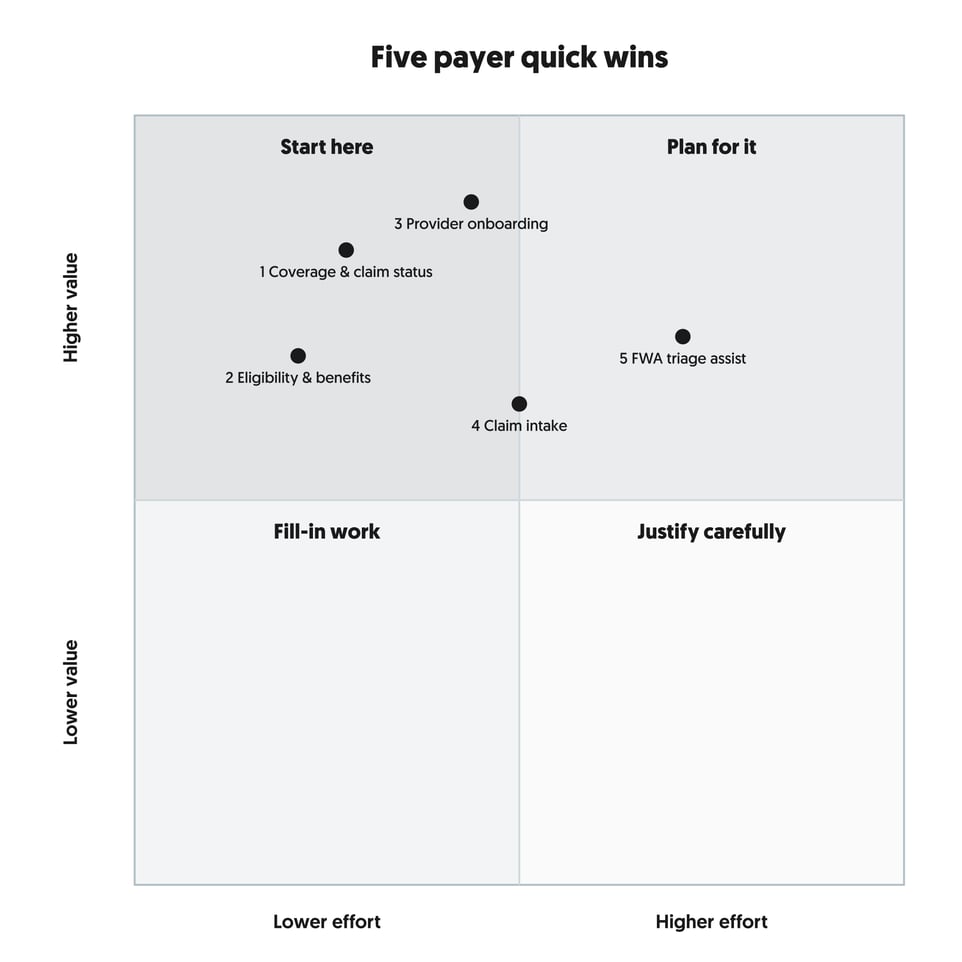
"Agentforce" can sound like a multi-year transformation programme. It doesn't have to be. The fastest-moving payers are treating it as a series of narrow, high-volume, low-risk wins: automate one painful workflow, prove the value, expand. Here are five that consistently land inside health and dental payers, each chosen because the workflow is high-volume, the rules are well-defined, and the risk of getting it wrong is contained.
FIG-2.1 · DIAGRAM
1. Coverage & claim-status agent (member self-service)
The single biggest driver of inbound call volume at most payers is "what's covered?" and "where's my claim?" Both are lookups against structured data. An agent that can authenticate a member, read their plan and claim records, and answer in plain language deflects a large share of routine contacts, and does it 24/7. Why it's a quick win: the data already exists, the answers are deterministic, and you can scope it to read-only first, removing most of the risk.
2. Eligibility & benefits lookup for provider and broker calls
Providers and brokers burn enormous time on hold confirming eligibility and benefits. An agent fronting that workflow, surfacing open authorisations, plan limits, and coverage details, cuts handle time and frees your specialists for the complex cases. Why it's a quick win: it's the same lookup pattern as #1, pointed at a different audience, so the second deployment is far cheaper than the first.
3. Provider onboarding & credentialing assistant
Onboarding and credentialing are document-heavy, rules-heavy, and slow, and every day of delay is a provider not seeing your members. An agent can guide the provider through submission, check for missing items, pre-populate from existing records, and flag exceptions for a human. Why it's a quick win: it doesn't replace the credentialing decision (which stays human), it just removes the chase, so the compliance risk stays low while the cycle-time win is large.
We didn't just list this one. We built it
To pressure-test how real this is, we built the onboarding assistant as a working Agentforce proof of concept: a provider-onboarding concierge for Meridian Dental Network, a fictional payer modelled on a real-world enrolment journey. It's worth walking through, because it shows what "the agent handles the routine 80%, the human gets the exceptions" looks like in practice.
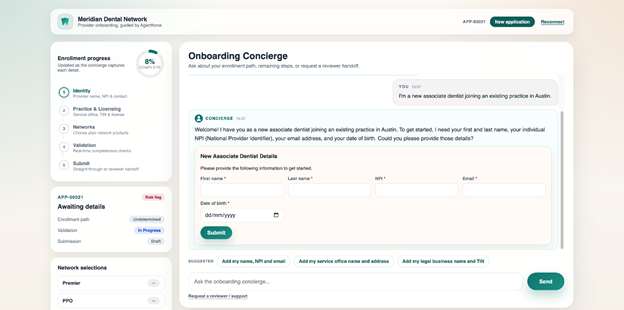
- It's a conversation, not a form. Instead of a ten-page multi-step wizard, the concierge talks the provider through it. It works out that they're a new associate joining an existing practice, then asks only the questions that path needs. Fewer dead-ends, less abandonment.
FIG-2.2 · SCREENSHOT
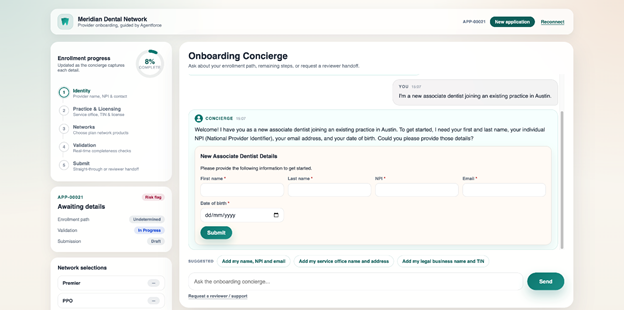
- It renders a real form when a form is better. Chat isn't always the right tool. When it needs several structured fields at once, the agent surfaces a native intake form inside the portal, with proper labelled inputs, pickers, and validation, rather than interrogating the provider one line at a time. Conversation and form, whichever fits the moment.
FIG-2.3 · SCREENSHOT
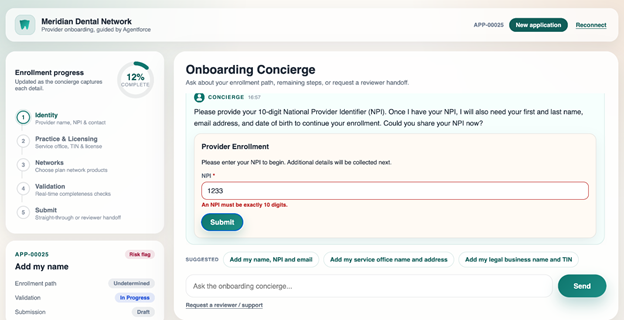
- It validates in real time and corrects rather than corrupts. A ten-digit NPI check runs as the provider types it. A date given as "3rd of March 1975" is normalised; data that can’t be pasted by the agent is skipped with a note, not saved as garbage. A specialty or provider type that isn't in the allowed list is left blank and flagged, not written in as junk. The record stays clean because bad data often leads to wasted effort in validating the correctness of the data.
FIG-2.4 · SCREENSHOT
- It saves as it goes, and it's resume safe. Every turn update one structured Salesforce record, with completion climbing as the picture fills in, and a later, thinner answer never wipes an earlier one. Close the tab and come back tomorrow, and the concierge picks up the same application where it was left, no duplicate created.
FIG-2.5 · SCREENSHOT (two-up)
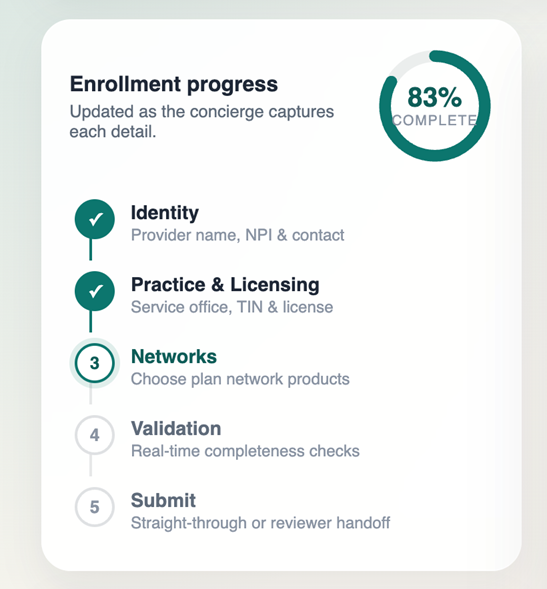
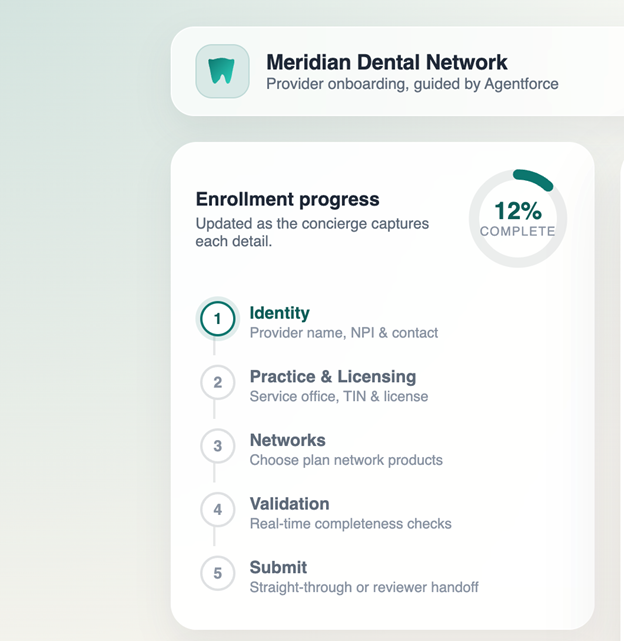
- It closes with a signed attestation, not a "submit" button. Before anything is final the provider must clear the required-field gate, accept the attestation, and sign, with typed legal name and date captured onto the record. They can download the completed application as a PDF for their own files. The submission becomes an auditable act, which is what a credentialing file must be.
- It knows when to get a human. When a submission is clean, the agent finalises it and confirms next steps. When something's off (a missing licence, a suspected duplicate, a high-risk case) it opens a review Case with a concise, structured summary of what happened and what decision is needed, so a person spends their time deciding, not reconstructing.
FIG-2.6 · SCREENSHOT
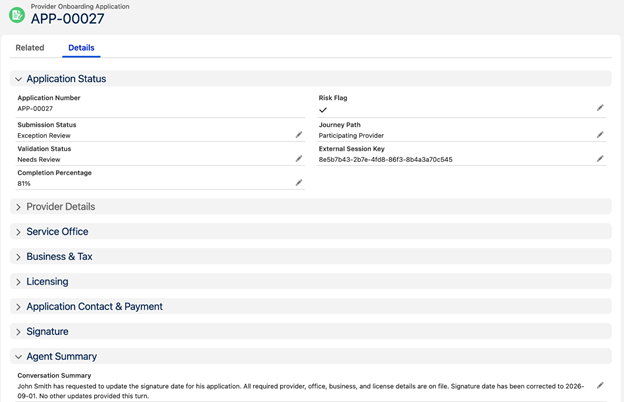
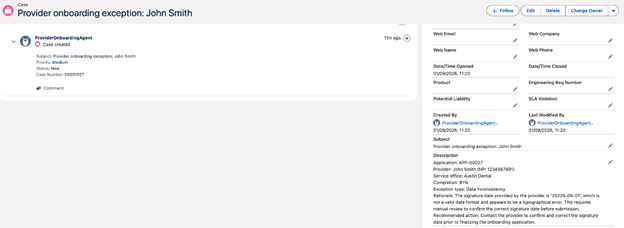
The agent never makes the credentialing decision. It removes the chase, guarantees a first time-right submission, and escalates judgement calls to people. Large cycle-time win contained compliance risk.
4. FNOL / claim-intake guidance
The first notice of a claim is where errors and friction enter the system. An agent that walks the claimant through a structured intake, collects required documentation, validates the basics, and creates a clean record means fewer rejections downstream and faster resolution. Why it's a quick win: you're improving data quality at the source, using the same "validate as you capture" approach the onboarding concierge uses, which pays dividends across every downstream process.
5. Fraud, waste & abuse triage assist
FWA review is high-skill and time-constrained; investigators can't look at everything. An agent that surfaces anomalies, clusters suspicious patterns, and prepares a case summary lets your investigators spend their time deciding rather than searching. Why it's a quick win: the agent assists rather than adjudicates, so you get throughput without handing judgement to a machine.
The common thread
None of these is "replace your people with AI." Each takes a high-volume, well-bounded task, lets an agent handle the routine 80%, and routes the exceptions to a human with full context. That approach ships in a quarter rather than a year, and it compounds: the second and third agents lean on the same guided-capture, validate-at-source, escalate-the-exception plumbing as the first.
There's a catch, and it's the reason we wrote the previous post in this series. Every one of these wins assumes the foundation underneath is sound: that the member record is unified, the claim data is reliable, the automations don't conflict, and the security model is tight enough to let an agent act safely. Where that's true, these are genuinely quick. Where it isn't, the "quick win" turns into a foundation project in disguise.
So, we always start with the architecture. Our Salesforce Architecture & Optimisation Review is built to answer one question for each of these use cases: can you ship this now, or is there a foundation gap to close first? The output is a roadmap that puts the real quick wins at the top, the agents you can deploy this quarter, and sequences the rest honestly.
→ Want a prioritised shortlist of the Agentforce quick wins your org can ship this quarter? That's the first thing our Review tells you. Book a Scoping Call and we'll define your Salesforce footprint and objectives in 30 minutes.