ARTICLE
Automation Debt Is Throttling Your Claims Throughout

8 West Consulting
Your Vision Realised

November 03, 2026
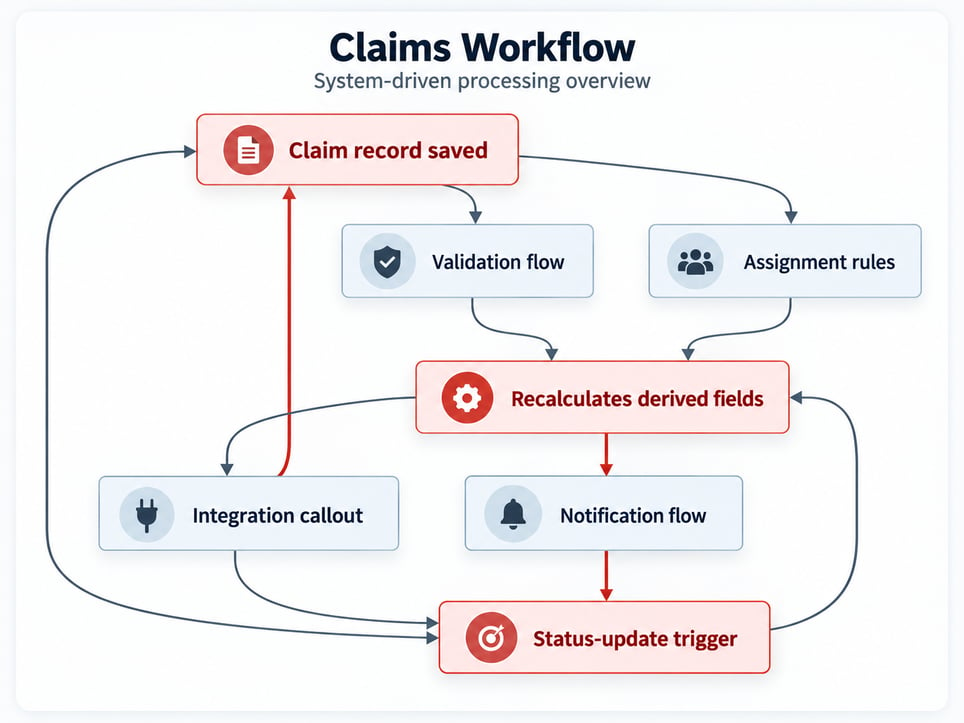
Ask any payer admin where the platform hurts, and claims throughput comes up fast. A claim record touches a dozen automations on its way through validation flows, assignment rules, status-update triggers, notification flows, integration callouts, built by different people, in different years, to solve different problems. Individually they're reasonable. Collectively they're automation debt: overlapping logic that recalculates the same fields, triggers that re-fire each other, and processes that quietly contend for the same records under load. The symptom is throughput: batches that time out, records that lock, a claim that takes four automations to move one status. The cause is architecture.
FIG-4.1 · DIAGRAM
That debt is expensive on its own. But it becomes dangerous the moment you point an agent at it.
An agent needs one clean path to act
A human working a queue can navigate a messy automation layer. They know that "you have to save twice" or "don't touch that field before this flow runs." An agent can't absorb tribal knowledge. When it goes to update a record and there are three code paths that could fire, with side effects that depend on order, the agent will confidently pick one and produce a result nobody intended. Automation debt doesn't just slow your existing processes; it puts a ceiling on what you can safely automate next.
The real question isn't "can an agent write to this object?" It's "is there one unambiguous way to write to this object that always leaves it in a correct state?" For most payer orgs, the answer today is no. That's fixable, and it's worth fixing before the agent project rather than during it.
What a clean write path looks like
When we built our provider-onboarding concierge for Meridian Dental Network, a conversational Agentforce agent that stands up a structured provider application from a chat, we couldn't hand-wave this. The agent writes to a real Salesforce record on almost every turn. If those writes had been ambiguous, the demo would have fallen apart on the first correction. So we designed the write path the way an agent needs it, and the same approach transfers directly to claims:
FIG-4.2 · DIAGRAM
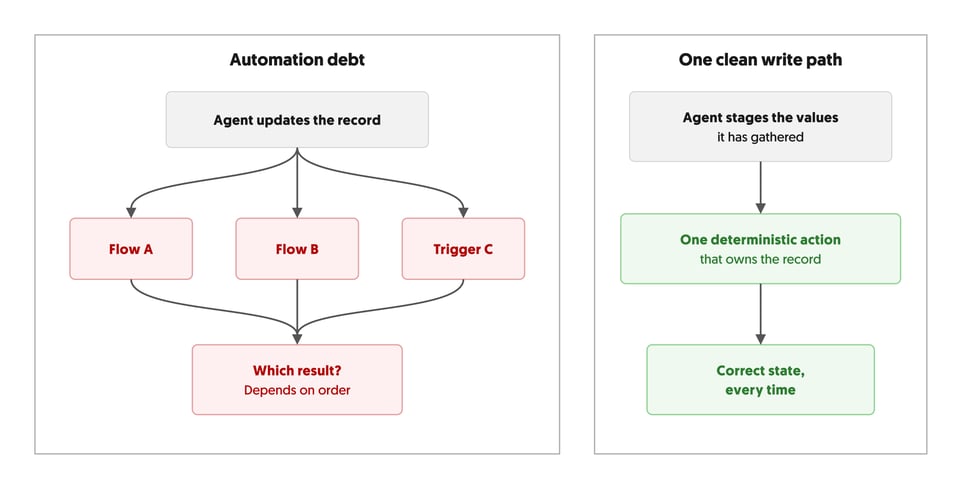
- Stage, then commit deterministically. The agent doesn't scatter writes through its reasoning. It stages the values it has gathered, and then a single, deterministic step commits them through one action that owns the record. The language model decides what to say; it does not get a vote on how the record is written. The conversation can afford to be non-deterministic because the persistence isn't.
- A thin update never clobbers a full one. If a later turn carries only one field (the provider correcting an email) it updates that field and leaves everything else intact. Partial information never erases prior information. In a claims context that's the difference between an agent "helpfully" blanking a field it didn't have a value for and one that only ever adds signal.
FIG-4.3 · TABLE
| Field | Turn 1 | Turn 2 | Turn 4 (correction) | Final record |
| Provider name | Dr A. Reyes | Dr A. Reyes | ||
| NPI | 1234567890 | 1234567890 | ||
| Practice TIN | 82-7654321 | 82-7654321 | ||
| a.reyes@old.example | a.reyes@new.example | a.reyes@new.example | ||
| Licence state | TX | TX |
Figure 4.3. A correction on turn 4 carries one field and changes one field. The other four values are never at risk. A blank cell means that turn didn't carry the field, not that it was cleared.
- The agent and your people don't fight over the record. The action recalculates its derived fields (completeness, validation state, a risk flag) only while the record is still a draft the agent owns. Once a human reviewer has taken it into a review or approved state, the automation deliberately steps back and stops overwriting their work. Contrast that with the classic automation-debt failure mode: a flow that "helpfully" recomputes a status a person just set by hand.
FIG-4.4 · DIAGRAM
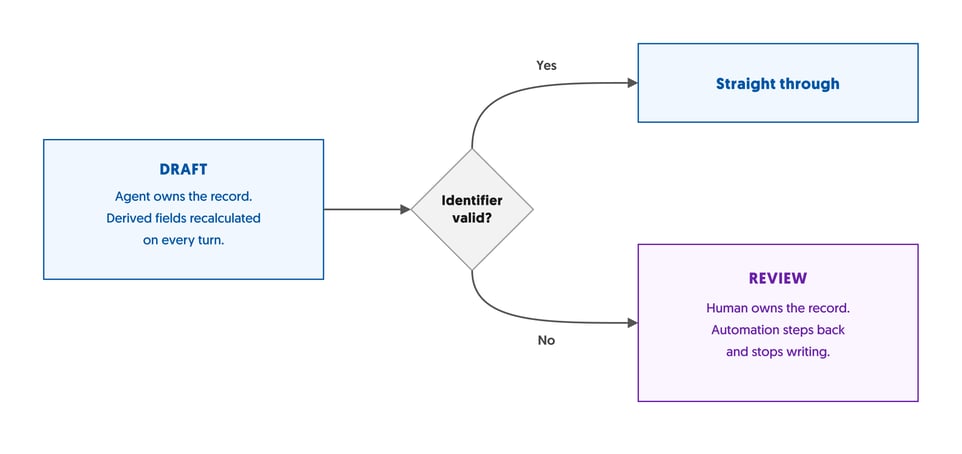
- One rule replaces a decision tree. Routing is a single, legible rule: a clean, valid identifier sends the application straight through; a malformed one routes it to human review and trips the risk flag. No nested branching, no five-flow cascade. One rule you can read, test, and trust.
None of that is exotic. It is what "Easy", the Salesforce Well-Architected lens for maintainable, efficient, automatable systems, looks like when you hold yourself to it.
The same four rules, on a claim
Onboarding is a convenient place to prove the pattern, because the record is small enough to reason about end to end. But nothing in those four rules is specific to provider data. Point them at a claim and they land in the same places. These are failure modes payer admins already recognise:
- Stage, then commit. A claim status change today may fire through whichever of the status trigger, the assignment rule, or the adjudication flow reaches it first, with side effects that depend on order. One owned "advance claim status" action means the transition is a single call with a single, testable result, and it's the same action whether a human, a batch, or an agent initiates it.
- A thin update never clobbers a full one. A status response from a clearinghouse carries three fields. If the integration writes the whole record, it silently blanks the adjuster's notes along the way. A thin update writes the three fields that arrived and touches nothing else.
- Automation steps back when a human takes over. Once an adjuster pends a claim for manual review, the nightly recalculation must stop recomputing its status, or their decision is reversed before morning. What that automation needs is an ownership boundary, not a patch.
- One rule, not a decision tree. A claim that passes its edits auto-adjudicates; one that fails routes to a work queue with the failing edit attached. One legible rule you can test, rather than routing logic smeared across five flows nobody wants to touch.
And notice the pay-off runs both ways: the same single-owner, deterministic write path that lets an agent act safely is also the one that stops your claims automations contending and timing out. Fixing the foundation for AI fixes throughput as a side effect.
Agents should retire automation, not stack on top of it
The trap to avoid is bolting an agent on top of the existing sprawl yet another actor writing to the same records. That doesn't reduce debt. It compounds it and adds a non-deterministic writer to a system that was already contending. Done well, an agent is an opportunity to consolidate: to replace three brittle, half-overlapping flows with one clean action the agent (and everything else) calls. The onboarding concierge doesn't add a sixth automation to the record; it routes through one, which is why it's predictable.
Where to start
You can't consolidate what you can't see. The first step is an honest inventory of the automation layer: which flows and triggers touch each object, where they overlap, where they contend, and which can be retired. That inventory, mapped against throughput and against your agent roadmap, is one of the core deliverables of our Salesforce Architecture & Optimisation Review. It tells you where automation debt is throttling claims today, and which records are clean enough to let an agent act on tomorrow.
→ Wondering how much of your throughput problem is automation debt, and whether an agent would help or make it worse?
Book a Scoping Call and we'll define your Salesforce footprint and objectives in 30 minutes.