ARTICLE
Why Agentforce Stalls Inside Health & Dental Payers (and the Foundation That Fixes It)

8 West Consulting
Your Vision Realised

October 06, 2026
Every health and dental payer leadership team has had the Agentforce conversation by now. The demo is compelling: an AI agent that resolves a member's coverage question in seconds, triages a claim, or guides a provider through onboarding without a human touching the case. The board is interested. A budget line appears. And then, three months later, the project is quietly stuck.
It rarely stalls because the technology doesn't work. It stalls because the org underneath it isn't ready.
Picture the onboarding agent from that demo running in production. A provider gives it an NPI that's nine digits, not ten. A second applicant looks suspiciously like a duplicate of one already in review. A third is a genuinely high-risk case that a human should see. In a clean environment, the agent validates, pauses, and escalates. In the environment most payers have, it confidently saves the malformed NPI, creates a second record for the duplicate, and routes the high-risk case straight through as approved, because nothing underneath told it not to. In a regulated payer environment, "confidently wrong" isn't a UX problem. It's a compliance incident.
FIG-1.1 · DIAGRAM
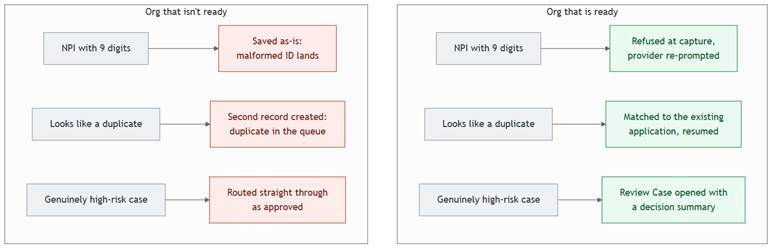
Figure 1.1. Three identical submissions, run against an unready org and a ready one. Only the foundation differs.
Agents are only as good as the platform they reason over. Point one at a data model that's been extended and re-extended for fifteen years, at automations that fight each other, at integrations that drop records under load, and at sharing rules nobody fully understands, and the failure above becomes entirely predictable.
We see the same readiness gaps repeatedly across claims, provider, and member-facing orgs:
- Automation sprawl. Flows and Apex triggers built by different teams over different years, duplicating logic and occasionally contradicting it. An agent asked to update a record now has three possible paths and no clean one.
- Brittle integrations. Eligibility, provider data, and claims live in separate systems stitched together by middleware that was never load-tested for the volumes an always-on agent generates.
- Fragmented data. The "member" exists in four places with three spellings. An agent grounded in that data inherits the fragmentation.
- Opaque security. Role hierarchies and sharing rules that made sense for a 50-person team, now governing what an autonomous agent can see and act on.
FIG-1.2 · DIAGRAM
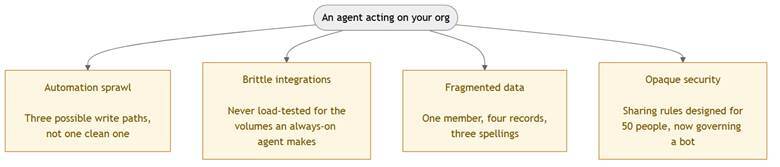
Figure 1.2. The four readiness gaps we see most often. Each one is survivable while humans are in the loop.
None of this means Agentforce is the wrong bet. It means the sequence is wrong. Most payers try to build the agent first and discover the foundation problems during the build, which is the most expensive possible time to find them.
So, we built one
We didn't want to argue this from the whiteboard, so we built the agent ourselves. Our provider-onboarding concierge is a working Agentforce proof of concept for Meridian Dental Network; a fictional payer modelled on a real-world enrolment journey. It guides a new associate provider through onboarding by conversation instead of a multi-step form: classifying the provider's path, asking only the questions that path needs, validating in real time, writing a structured record to Salesforce, and handing the ambiguous cases to a human reviewer with a concise summary.
FIG-1.3 · SCREENSHOT
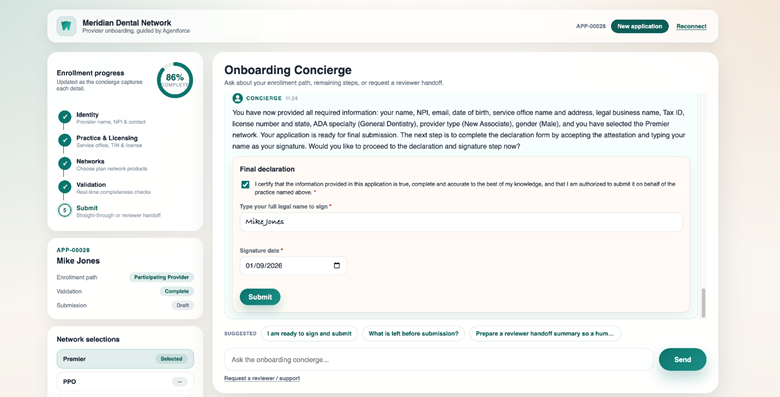
Figure 1.3. The concierge mid-conversation, with the status rail on the right reading a live Salesforce record.
Building it turned every one of the readiness gaps above into a design decision we had to get right before the agent could be trusted to act.
- The automation gap forced us to give the agent one clean, deterministic path to write, rather than three flows racing for the same record.
- The data gap forced validation at the point of capture: a ten-digit NPI check, dates normalised or refused, off-vocabulary values dropped rather than saved as junk. The agent grounds on data it can trust.
- The security gap forced a least-privilege model where the agent's user can do what the job requires and nothing more, and no record ID or token ever leaks to the browser.
- The integration gap forced the connection to the Agent API to degrade gracefully, never fabricating a status when the live service is unavailable.
The Well-Architected pillars every Salesforce architect already knows (Trusted, Easy, Adaptable) are not separate from your AI strategy. They are the prerequisites. Get them right and Agentforce stops being a risky moonshot and becomes a series of incremental deployments.
FIG-1.4 · TABLE
| Well-Architected pillar | What it became in the build | Covered in |
|
Trusted (secure, compliant, reliable) |
Least-privilege agent identity; no record ID or token at the browser edge | Single-Org vs Multi-Org for Growing Payers |
| Easy (maintainable, efficient, automatable) | One deterministic write path, not three flows racing for the record | Automation Debt Is Throttling Your Claims Throughput |
| Adaptable (resilient, interoperable, composable) | Validation at capture; an Agent API connection that degrades without fabricating | Data You Can Trust: Getting Payer Data Agentforce-Ready |
Figure 1.4. Each pillar, and the design constraint it turned into. The rest of the series takes them one at a time.
Start with the foundation, not the agent
There's a faster, cheaper sequence than building-then-discovering: assess the foundation first, in days, against a known standard.
Our Salesforce Architecture & Optimisation Review is built to do exactly that. It's a fixed-scope, fixed-fee engagement that evaluates your org against the Salesforce Well-Architected frameworks, through the lenses of Trusted (secure, compliant, reliable), Easy (maintainable, efficient, automatable), and Adaptable (resilient, interoperable, composable). In ten working days plus a read-out you get a clear picture of where your org is agent-ready, where it isn't, and a prioritised roadmap that separates the quick wins you can ship now from the medium-term and strategic work.
And you don't have to wait for the full roadmap to feel value. Most reviews surface several quick wins in the first few days: a redundant automation layer that can be retired, an ingestion bottleneck that can be widened, a sharing rule that's over-exposing data. Those alone often pay back the engagement before the agent strategy even begins.
If Agentforce is on your roadmap, or if it stalled and you're not sure why, the foundation is the place to start. In the next post we'll get specific: five Agentforce quick wins payers can realistically ship this quarter, including the onboarding concierge we just described.
→ Want to know if your org is agent-ready? Book a Scoping Call and we'll define your Salesforce footprint and objectives in 30 minutes.