ARTICLE
Two Senior Engineers Completed OpenAI Certification Courses. Their Biggest Lesson Wasn’t in the Curriculum.


8 West Consulting
Your Vision Realised

November 05, 2026
When we recently asked two of our senior software architects to complete OpenAI’s partner training catalogue, we expected a detailed debrief on emerging frameworks, optimisation techniques, and production-ready architectural patterns.
Over the course of two weeks, they worked through the full spectrum of nine practitioner certifications across the OpenAI Partner Network:
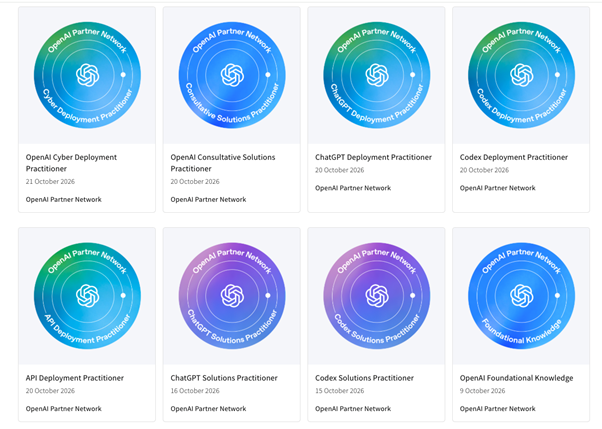
Despite the wide variation in course titles, spanning everything from cybersecurity and API deployment to consultative solution design, the technical depth delivered across these modules did not match what a senior engineer needs to build mission-critical enterprise systems. Most of the material was aimed at business analysts and presales functions rather than software developers, focusing heavily on how to "sell" ChatGPT rather than how to architect, integrate, and deploy non-deterministic models in production.
This is not a reason to completely dismiss OpenAI's training. Some of it is clearly written for non-technical audiences, and as general AI literacy, it has value.
Instead, their debrief revealed an uncomfortable reality about the current state of enterprise AI education: the material exhibited the very traits of unvetted, poorly supervised AI output that enterprise leaders are trying to eliminate.
What They Found
Across the entire curriculum, both persons noted a pattern of compromised presentation quality, repetitive content, and easy-to-pass tests:
- Unedited AI Generation Artifacts: Multiple-choice quiz options included raw prompt remnants like “(this is an incorrect answer)”, pointing to an automated content generation pipeline that lacked human proofreading. Elsewhere, published modules went live with default placeholders such as "Page Title Here".
- Gaming the Assessments: The multiple-choice quizzes proved almost entirely cosmetic. An examinee could achieve an 80% to 90% pass rate simply by selecting the longest answer option every time, without engaging with the material. Out of nine comprehensive courses, only three labs required human validation.
- Superficial UI and "AI Slop": Meaningful technical diagrams and architectural illustrations were substituted with decorative colour-gradient blocks. Adding to the frustration, these decorative gradients were wired as interactive UI elements, allowing users to click on a generic green-and-purple gradient block to open a high-resolution, zoomed-in view of the exact same gradient.
There is a stark irony in an AI pioneer publishing training that exhibits these hallmarks of unreviewed generative output. But for enterprise technology leaders, this experience points to a much larger, more expensive risk: the dangerous gap between vendor AI certification and genuine AI engineering competence.
As organisations adopt AI-First strategies, many risk mistaking vendor course completion for operational execution. Declaring an AI-First policy sets an ambitious strategic direction, but if its execution relies on engineers whose primary training consisted of learning how to prompt ChatGPT rather than architect resilient systems, that strategy sits on fragile ground.
From AI-First Intent to AI-Better Execution
An AI-First directive is a powerful catalyst for organisational change. It signals to teams that innovation, automation, and intelligent capabilities are top business priorities.
However, an AI-First commitment only succeeds when supported by an AI-Better approach to execution.
Being AI-Better means pairing high strategic ambition with rigorous engineering discipline. It means investing heavily in artificial intelligence while remaining clear-eyed about its current limitations, applying the technology where it delivers genuine value while maintaining uncompromising engineering standards across the board. Crucially, it requires a willingness to evaluate tools critically and challenge vendor narratives, even those from major AI providers.
What Engineers Need That Most Courses Skip
In production, AI work depends on skills that rarely appear in introductory training:
- Solution architecture and integration with existing systems
- Evaluation: measuring accuracy and reliability
- Security and privacy
- Handling hallucinations
- Cost control
- Reliable operation
We would also add judgment on where AI is the wrong tool and conventional software is better.
What CIOs and CTOs Can Do
If you are leading an enterprise technology organisation with an AI-First strategy, driving genuine capability requires shifting focus from badge collection to practical engineering outcomes:
What we see working:
- Match training to role. Separate paths for business users and engineers.
- Assess outcomes, not certificates. Ask engineers to design, build, test, and defend a working prototype that integrates an LLM safely.
- Review AI-generated output. Apply human validation to documentation, training material, and code.
- Question your delivery partners:
- How do you determine the right balance between generative models and traditional software architecture for a given use case?
- How do you continuously evaluate and mitigate hallucinations in a live environment?
- What specific mechanisms do you use to prevent prompt injection and secure sensitive data?
- How do you monitor and optimise model latency and token expenditure under peak loads?
- Can you demonstrate a production AI system you've deployed, including its accuracy metrics and uptime?
Engineering Standards Still Decide The Outcome
AI is reshaping enterprise software architecture, but the core principles of sound system engineering remain unchanged. Reliability, data privacy, security, maintainability, and cost control remain the true metrics of successful technology leadership.
Vendor courses and certifications can serve as a helpful starting point for general AI literacy across different domains. But turning an AI-First ambition into a sustainable, high-performance operational advantage demands critical thinking, rigorous testing, and battle-tested engineering discipline.