ARTICLE
Why Build in React Native

Alison McDonnell
Project Manager, 8 West Consulting

February 13, 2025
What do I need from my mobile app?
Some apps require advanced hardware interaction, highly specific platform features, or maximum performance. Examples include AR/VR apps, high-end gaming, or apps that rely heavily on low-level system integrations. In these instances, native development using Swift or Kotlin is often the best choice.
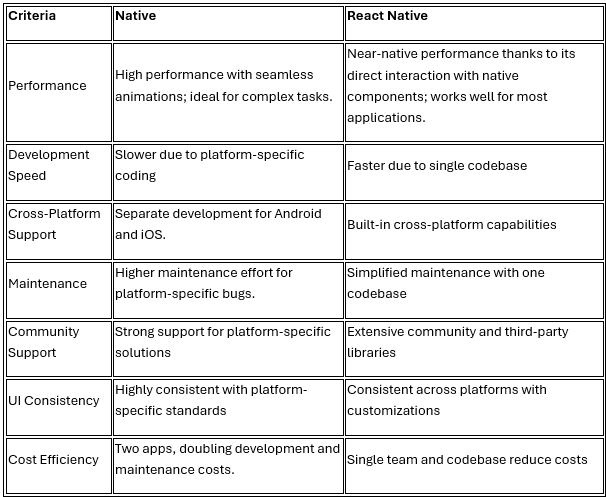
But what if your app doesn’t have such specific needs? Is sticking with native development still necessary? With native apps, you’ll need to build and maintain two separate codebases—one for Android and another for iOS. React Native, on the other hand, allows you to streamline development by building a single app for both platforms, reducing complexity, development time, and maintenance costs.
Why Choose React Native?
React Native offers several advantages for mobile app development, depending on your project's goals and constraints. Here's how it compares to native development:
Additional Considerations
- Team Expertise: If your team has experience with React for web development, transitioning to React Native is relatively straightforward. Its syntax and component-based approach reduce the learning curve.
- Flexibility: React Native supports third-party plugins and allows bridging native modules when necessary, providing the flexibility to handle platform-specific requirements.
- Industry Backing: React Native is maintained by Meta (formerly Facebook) and used by companies like Instagram, Airbnb, and Shopify, ensuring reliability and ongoing improvements.
- Talent Pool: The popularity of React Native makes it easier to find skilled developers, simplifying hiring and team expansion.
Already Have a Native App?
If you already have a native app but it doesn’t have the native-specific requirements we mentioned earlier, transitioning to React Native can be a strategic move to future-proof your app. By consolidating your codebase into a single, cross-platform solution, you can reduce development time and ongoing maintenance costs while still delivering a high-quality user experience. React Native's ability to integrate seamlessly with existing native components ensures that you don't lose any of your existing platform-specific functionality while gaining scalability and flexibility for future updates. This approach is ideal for businesses looking to optimize resources, expand their app’s reach to new platforms, or streamline feature development.
Will I or Won’t I?
Just to be clear, moving to React Native isn’t suddenly going to make all your development concerns vanish. It comes with its own set of challenges that teams should be prepared to address.
- First, while React Native allows for cross-platform development, it still requires expertise in mobile app development to handle platform-specific nuances and performance optimizations effectively.
- Additionally, deploying iOS apps involves stringent hardware requirements, such as access to a macOS environment for building and testing. Robust testing and deployment processes are essential to ensure the app performs consistently across both platforms, particularly when integrating native modules or third-party plugins.
- Finally, understanding the tradeoffs in React Native development is crucial—while it offers near-native performance and shared codebases, it may not be ideal for highly complex or hardware-intensive applications. Recognizing and addressing these challenges can help teams fully leverage React Native’s capabilities while minimizing potential roadblocks.
React Native offers a powerful middle ground for businesses seeking cost-efficient, cross-platform mobile app development without sacrificing user experience. For many applications, it provides the best of both worlds— scalability and performance.
How 8 West Can Help
At 8 West, we specialize in both Native and React Native development. As shown in the One Hope Wine case study, we demonstrated how we transformed an existing Swift app into a cross-platform solution. Instead of the client investing time and resources in developing and maintaining separate iOS and Android apps, we delivered a single app that seamlessly works across both platforms. This approach significantly reduced development time, costs, and ongoing support requirements, all while ensuring an exceptional user experience.
8 West offer a no-obligation assessment for businesses. We will meet with you and your team, understand what your current and future requirements are and provide tailored guidance for your transition to React Native.
We take pride in delivering solutions that align with our clients' goals while embracing industry best practices. We are excited to continue leveraging the capabilities of React Native to create impactful and scalable applications that empower businesses and delight users.